
Fort Bend County City Directory Collections
The identified Richmond run is useful precisely because its gaps are known. R. L. Polk & Co. volumes are listed for 1921-22, 1931, 1933, 1951, 1956, 1958, 1961, 1965, 1977, 1978, and 1983. Richmond telephone volumes are listed for November 1947, October 1955, and October 1956. These are holdings leads, not a promise of uninterrupted publication or a countywide roster. Check the volume’s community headings, street guide, and classified pages before treating a missing name as an absence from Fort Bend County.
| Collection | Years | Where Held | Access |
|---|---|---|---|
| Polk’s Richmond directories | 1921-22, 1931, 1933, 1951, 1956, 1958, 1961, 1965, 1977, 1978, 1983 | Verify with George Memorial, TSLAC, or WorldCat | Reference, on-site, or catalog inquiry |
| Richmond telephone directories | November 1947; October 1955; October 1956 | Local holdings lead; Briscoe Center as a backup | Reference, microfilm, or catalog inquiry |
| Fort Bend Libraries partner materials | Items dated 1880-1985 | UNT Portal to Texas History | Free web browse, item coverage varies |
| Texas city-directory collections | Varied cities and years | Texas State Library and Archives Commission | Print or microform in the Austin Reading Room |
Rural places, postal names, and newer communities may sit outside a Richmond volume or under a broader telephone exchange. Retain the town or post-office name printed in the source. A modern city label should be a separate research note, not a replacement for the historical form.
Fort Bend County Richmond Directory Years
The early Polk listing begins with 1921-22, then skips to 1931 and 1933 before later volumes appear. That pattern matters when tracing a household. A name found in 1931 and 1933 may establish a short interval, but it cannot establish continuous residence through the missing years. The same caution applies to the three identified telephone books. Their dates are search opportunities, not a full sequence.
The Fort Bend County Libraries partner collection provides a local dated browse route for digitized material.
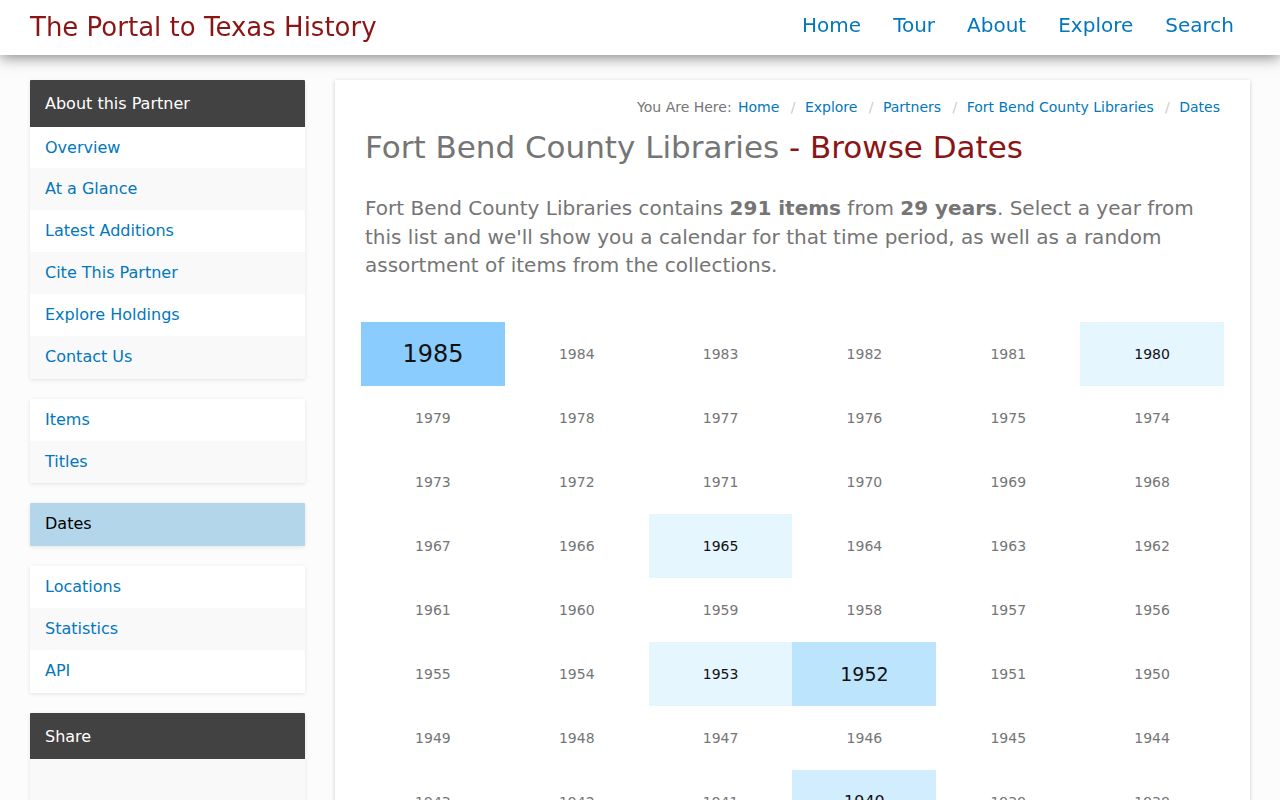
Dates shown in that collection range from 1880 to 1985, but the browse range does not prove that every year or every directory page is online.
Fort Bend County Directory Room
George Memorial Library is the practical local counter for a hard-to-locate volume. Its Genealogy and Local History Department is on the second floor at 1001 Golfview Drive in Richmond. Posted hours are Monday and Thursday from 9 a.m. to 9 p.m., Tuesday and Wednesday from 9 a.m. to 6 p.m., Friday and Saturday from 10 a.m. to 5 p.m., and Sunday from 1 p.m. to 5 p.m. The department can be reached at 281-341-2608.
The George Memorial genealogy and local-history resources describe the library channel for historical directories, newspapers, burial records, and microfilm.
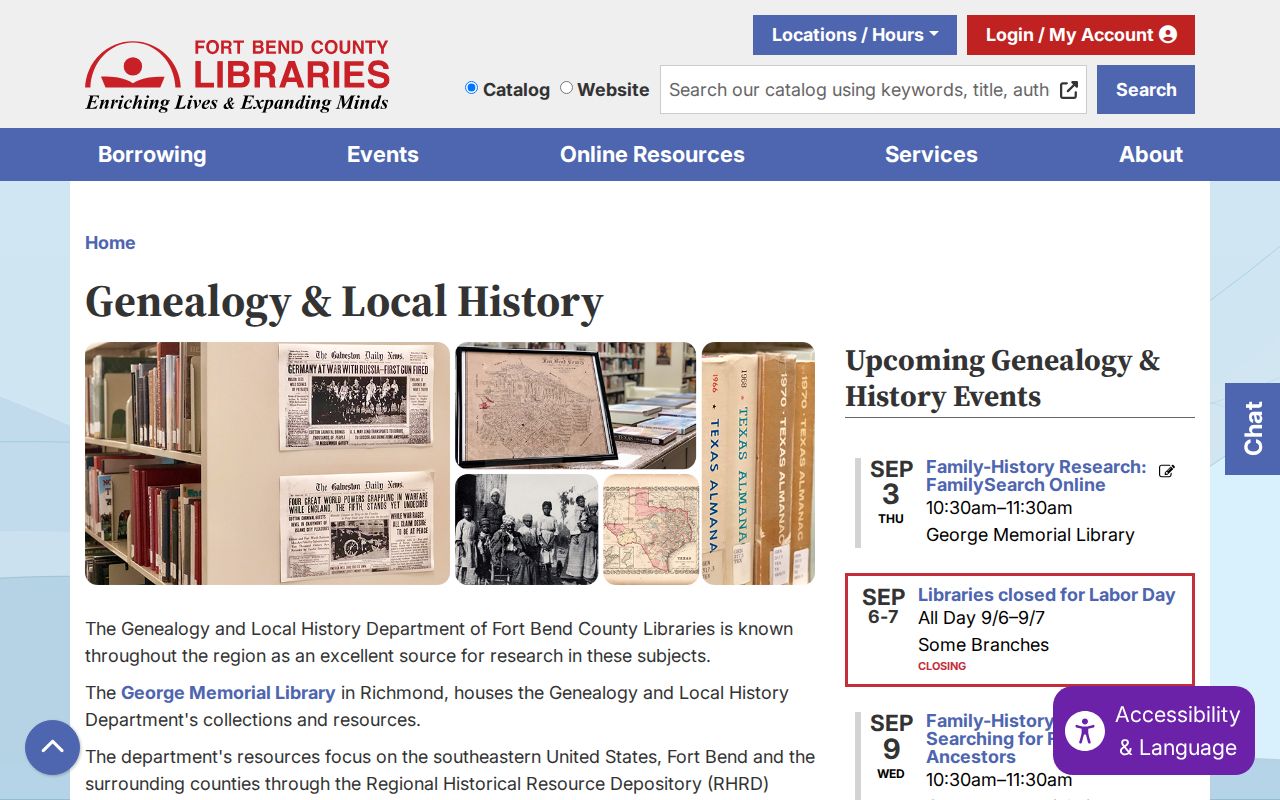
Public reader-printers are available there, and microfilm copies carry a listed 10-cent-per-page coin charge. Call before a visit to confirm a particular Richmond or telephone volume.
Reading Fort Bend County Directory Entries
A Fort Bend County city directory entry should be read as a printed observation, not as proof of every person in a home. The Texas State Library describes common fields as name, address, telephone, spouse, occupation, and sometimes an owned or rented status. Record exactly what the volume presents, including initials, name variants, and any address term such as an apartment or room. Do not expand an abbreviation until the publisher’s own key has been checked.
| Name | Alphabetical surname and given name, including initials or spelling variants. |
|---|---|
| Household clues | Spouse or widow/widower notation where the volume collects it. |
| Work clue | Occupation and business or employer affiliation where printed. |
| Place clue | House, apartment, room, or other address wording, plus a telephone number where present. |
| Status marks | Owner or renter notation only when the particular volume supplies one. |
- Criss-cross directory
- Where present, an address-order section that can lead from a street location to printed occupants.
- Householder index
- An alphabetical arrangement that centers the named household or address rather than a business category.
- Abbreviation key
- The publisher’s explanation of its marks. Photograph or transcribe it before interpreting a local entry.
The Texas State Library city-directory guide explains the broader Texas collection routes and the normal kinds of fields found in directories.
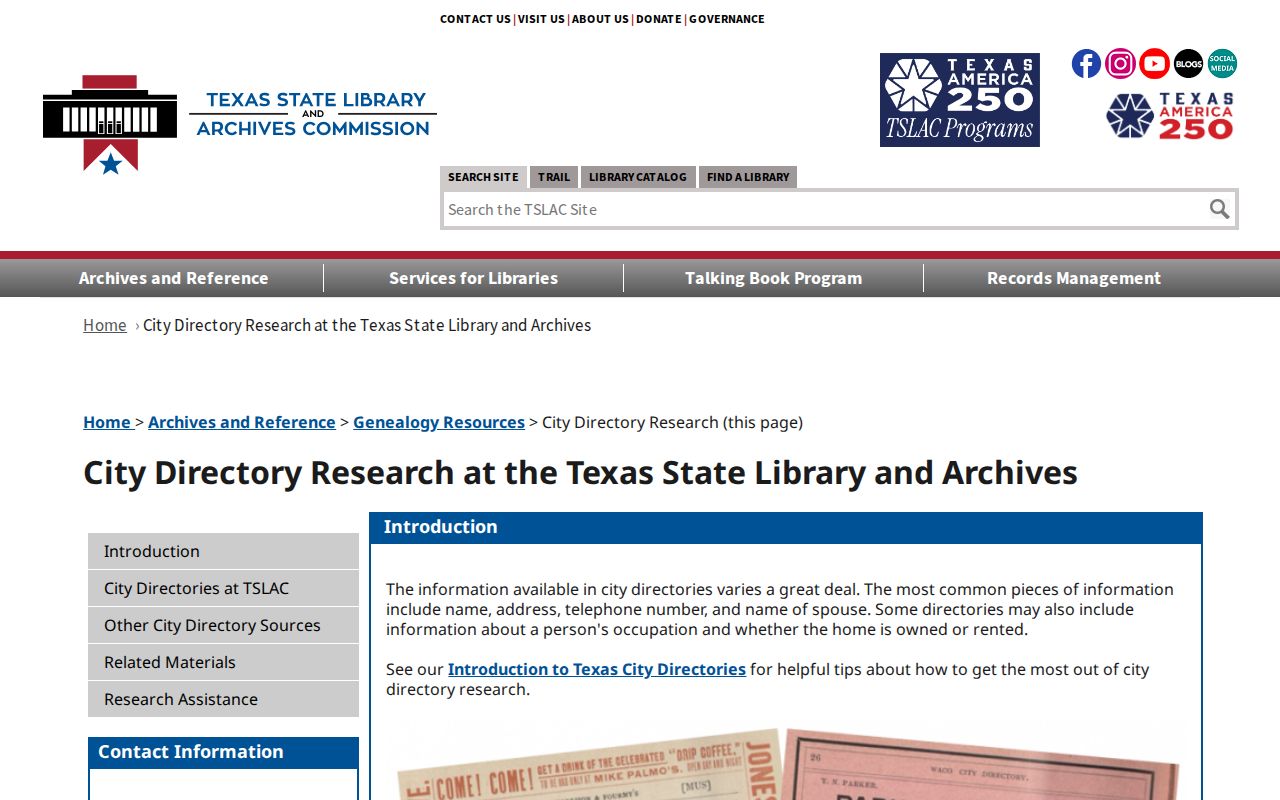
No actual Fort Bend entry page or local abbreviation key was captured in the research. Keep a source note for the volume and page rather than inventing a transcription.
Fort Bend County Obituary Searches
When a household disappears between directory dates, the library obituary database can help test whether a death, family move, or spelling change is involved. It supports Boolean AND, OR, and NOT; quoted phrases; the * wildcard; the one-character ? wildcard; surname browse; and cemetery browse. Search a name with a community or spouse term, then save the citation rather than relying on a result snippet.
The Fort Bend obituary search tips show the available phrase, wildcard, and browse controls.
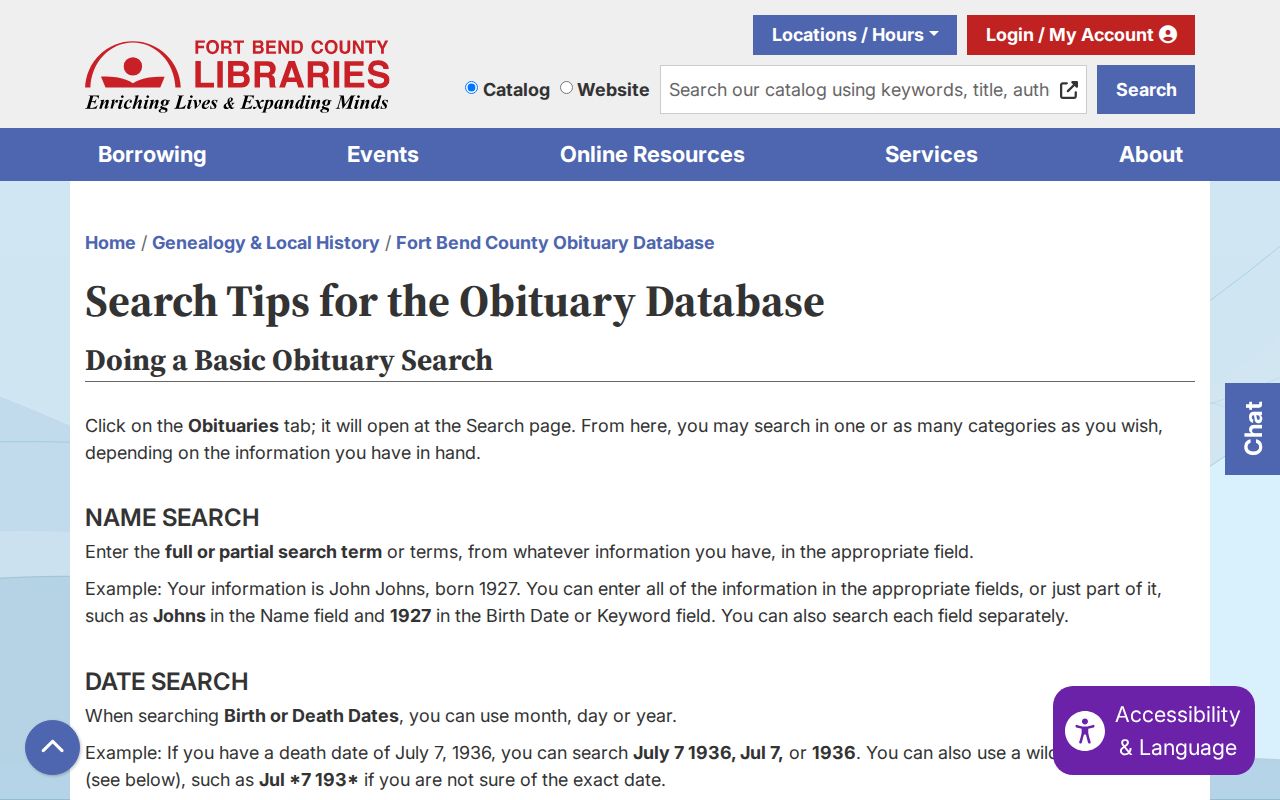
Burial volumes and cemetery results can close a family trail, although the library notes that known or listed graves may be incomplete.
Fort Bend County Archive Records
Some community names never appear in a directory. The Fort Bend County Historical Commission archives add the Knight & White Papers, oral histories, cemetery resources, and archival folders to the search. Its archive search offers Keyword, Category, Subcategory, and Historical Period controls. A surname, church, cemetery, landmark, or place variant can point to an item that explains a name or community reference in a directory.
Oral histories are recollections, not recorded title evidence. Preserve the interview or item metadata, then compare it with the directory page, obituary, deed, or other primary record. The Historical Commission also provides a trail where a local street or school name survives only in community memory.
The Fort Bend County Historical Commission archives are the documented heritage fallback for that work.
Tracing Fort Bend County City Directories
Use the known local volumes as dated stops in a household trail. Begin with the address, town or post-office name, street suffix, and directional prefix found in a deed, map, family paper, or obituary. A reverse section is helpful when present; otherwise use the street guide and alphabetical entries. List every person the volume places at the address, while remembering that the publication method may omit people.
- Locate the first identified directory year for the name or address, and copy the entry without modernizing it.
- Check the next identified Richmond or telephone volume, noting address changes, spouse information, occupations, and phone clues.
- Pair a directory date with a released federal census year. The census can add household relationships and ages, while the directory can fill time between enumerations.
- Bridge a gap with a recorded deed, probate file, obituary, burial result, or marriage index before deciding why the name changed or disappeared.
A disappearance can reflect a move, death, marriage, omission, changed boundary, altered spelling, or a different person. The historical collections remain separate from the current address chain described in the Fort Bend County street directory.
Fort Bend County Directory Backups
When a local shelf does not hold the needed date, TSLAC’s Austin Reading Room is an on-site fallback for its print and microform directories. The library guide also points to the UT Briscoe Center’s Texas telephone and city-directory collection, in-library Ancestry Library Edition, HeritageQuest where library or TexShare access applies, WorldCat, and the Library of Congress. Each route has different holdings, so search the town and date rather than assuming countywide coverage.
Fort Bend County was organized in 1837, and older records may use community, post-office, lot, block, abstract, or survey names instead of a current street address. Preserve those terms first. The library’s July 2026 genealogy programming is another reminder that current services and catalog access can change.
The Fort Bend Libraries genealogy-program notice documents a current local-history service connection.

Confirm availability and access terms with the holding institution before planning a visit or relying on a catalog result.
Fort Bend County Directory Gaps
No reviewed official source establishes a first-ever Richmond directory year, a last printed year, or a complete shelf list for every Fort Bend County community. The identified holdings begin with Polk Richmond 1921-22 and continue irregularly through 1983. A library, archive, or catalog search may reveal more material, but a collection date or an online-library statement does not establish that every original volume or page is available.
Gaps are useful research facts. Mark the last confirmed appearance, the next confirmed appearance, and the records used to bridge them. Deeds, telephone books, census schedules, obituaries, probate, microfilm, and the Historical Commission archives can narrow an interval without turning an unverified year into a claim.