
Fort Bend County Previous Residents Sources
A backward address trail starts with a clear distinction: an owner record is not the same as an occupant record. Fort Bend County’s recorded instruments establish a title trail, while appraisal data gives a current parcel lead. Historical directories, telephone books, census schedules, obituaries, and probate material can then help identify people associated with a place. Each source is dated and incomplete in a different way, so keep the source name and date beside every name.
| Source | Years It Covers | Where Held | What It Shows |
|---|---|---|---|
| County Clerk online public-record library | 1821 to present, as described by the county | County Clerk Official Public Records | Recorded instruments and party-centered deed leads |
| TSLAC deed index and deed records | Index 1837-1897; deeds 1838-1886 | Texas State Library microfilm inventory | Older grantor, grantee, and recorded-land trail |
| Identified Richmond directories | Irregular volumes from 1921-22 through 1983 | George Memorial, TSLAC, or catalog inquiry | Printed household, address, occupation, and phone clues |
| Federal census schedules | 1790-1950 public schedules | NARA, FamilySearch, or library access | Household relationships and ages after proper location work |
Start with the newest reliable record and move backward. Previous residents can emerge from a sequence of dated sources, not from one current parcel display. A historic address may need the directory, deed, census, and plat trail together because older county records often use a lot, block, abstract, survey, community, or post-office name rather than a modern street label.
Fort Bend County Resident Parcel Start
Fort Bend Central Appraisal District, known as FBCAD, is the current-property lead. Its eSearch form includes owner name, street number, street name, Quick Ref ID, Geographic ID, subdivision, neighborhood, and tax-year controls. Copy the account or Quick Ref ID, geographic ID, situs address, owner display, legal description, and tax year before looking for prior records. The displayed roll is identified as the 2026 certified roll, so its owner display should be time-stamped.
The Fort Bend Central Appraisal District property search is an appraisal and account source, not a substitute for the recorded deed. A mailing address is also not proof that an owner occupies the property. Use FBCAD to form the parcel lead, then use the legal description and owner name in the Clerk’s records.
Fort Bend County Deed Records Chain
The County Clerk’s Official Public Records system is party-centered. It describes searches by party name, grantor, grantee, date filed, instrument number, and document type, rather than a direct address index. The latest purchase deed usually identifies the seller and the legal description needed for the next search. Preserve the actual instrument number, recording date, parties, document type, legal description, volume or page reference if shown, and source URL.
- Use the current FBCAD parcel record to capture the owner name, situs, parcel identifiers, and legal description.
- Search the County Clerk recorded-document index for the deed that placed that owner in title.
- Record the seller, who is the grantor on that deed, then search that seller as a grantee to locate the earlier purchase.
- Repeat the sequence backward, keeping name variants and legal descriptions with each instrument.
- Move to the TSLAC microfilm trail when the earlier record needs reel-level research or online image coverage is unclear.
- Grantor
- The person or entity transferring an interest in a recorded instrument.
- Grantee
- The person or entity receiving that interest. In a backward deed trail, a prior seller becomes the next name to search as a grantee.
- Chain of title
- The dated sequence of recorded transfers and related instruments for the same property.
- Legal description
- The lot, block, subdivision, abstract, survey, or other formal land description that connects records when street names change.
A name match alone does not tie an instrument to the target parcel. Compare the legal description, subdivision or survey wording, instrument date, and role of each party before carrying a name backward. That record note also makes it possible to revisit a link when a later deed or plat corrects the address trail.
Fort Bend County Index Search Clues
Not every recorded document transfers ownership. A deed of trust, release, lien, power of attorney, or similar filing can explain a relationship to a parcel without placing title in a new owner. Plats are also important. They can join a lot, block, and subdivision to an address, but a plat alone does not establish who owned the land at a later date. Mark the document type before adding it to a chain.
The County Clerk’s online-library range is described as 1821 to present, but that statement does not prove that every original image is online or available without the portal’s session and access steps. The Clerk’s FAQ and its supported search fields control the search method. Keep a note when an image is unavailable, restricted, or requires another access channel.
Fort Bend County Microfilm Records Warnings
The Texas State Library’s Fort Bend inventory supplies a precise older route: the deed index for 1837-1897 is Reel 1007968, and deed volumes A through R are on Reels 1007969-1007982. The guide also lists deeds from 1838-1886. These dates are stronger evidence for an early land search than treating the modern portal description as proof of complete online image access.
The Texas State Library Fort Bend microfilm inventory documents the older deed runs and reel notes.
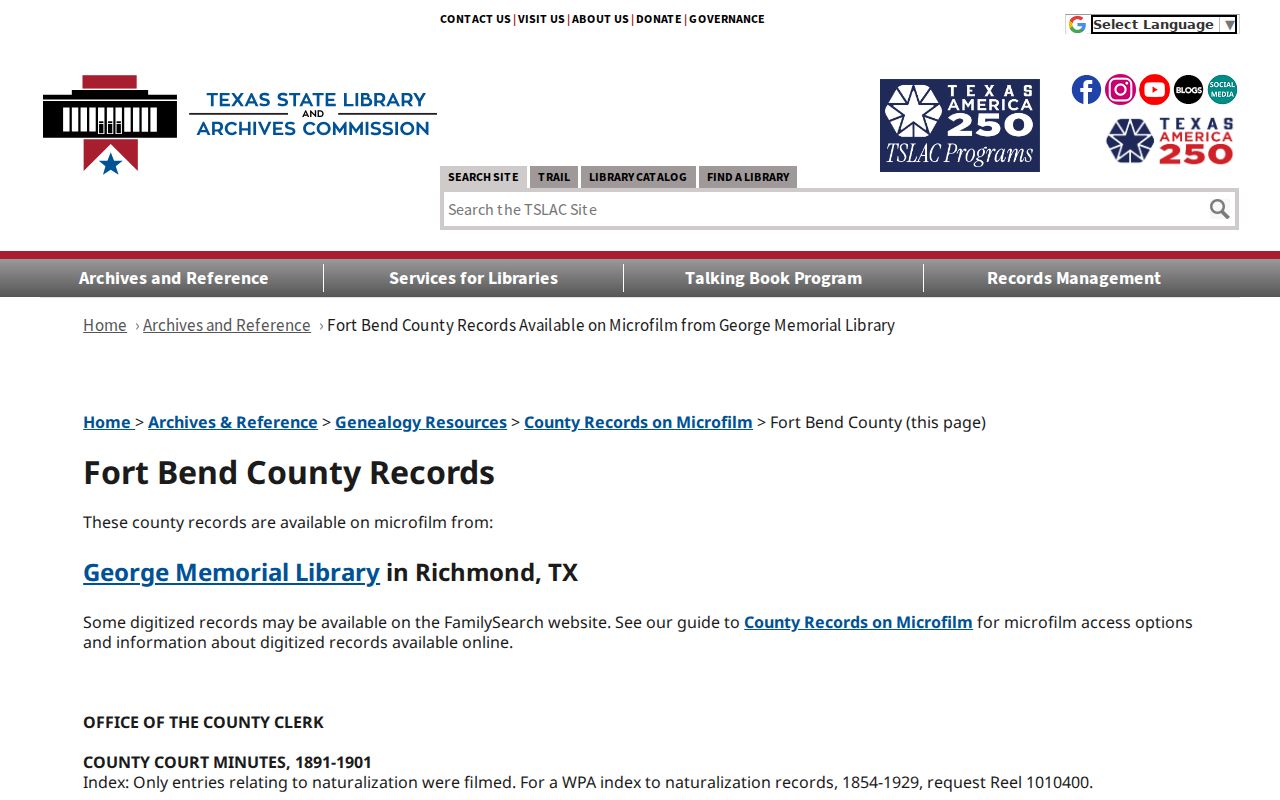
Carry the anomaly notes with the citation: Deed Volume D pages 1-48 are missing, and Volume F pages 271-290 were filmed twice, with the second filming a transcription. Probate labels are also unreliable, so use the guide’s arrangement rather than a volume title alone.
Fort Bend County Address Record Labels
One property can have several valid descriptions. FBCAD uses a situs address and parcel identifiers. County GIS supplies mapped address points and attributes such as postal city, ZIP, city or ETJ status, alias, street components, and address class. The County Clerk relies on parties, instruments, and the legal description. Write down each label as given instead of forcing the sources into one modern address form.
A plat can bridge a subdivision lot or block to the street address. GIS can help distinguish an address point from a parcel polygon. Neither tool establishes title on its own. This careful separation helps prevent a past-residents trail from joining an adjacent lot or a similarly named subdivision to the wrong home.
Fort Bend County Address Gaps
No reviewed source verifies a countywide street-renumbering story for Fort Bend County. An older record may instead use a rural community, postal place, subdivision, lot and block, abstract, or survey label. Preserve the raw wording before adding a modern address note. A current city or postal label should never silently replace the historical form.
An address gap is not proof that a house, family, or street disappeared. Test the legal description against plats, directories, census geography, and GIS only after recording the original wording. That sequence keeps a historical place-name change from becoming a mistaken previous-residents match.
Fort Bend County Past Household Pairing
Ownership is only half the address story. The identified Richmond Polk volumes and telephone books may place a name, spouse, occupation, address, or phone clue at a point between censuses. Pair a dated directory entry with a released federal census schedule, then test the same address or community in an obituary, recorded deed, probate entry, or burial result. A directory is a printed observation, not proof of every member of a household.
Use this sequence: current parcel and legal description → purchase deed → prior seller as the next grantee search → directory or telephone-book date → released census household → obituary, burial, or probate endpoint. The actual holdings and entry-reading method are detailed in the Fort Bend County city directory collections.
Lawful personal use. Fort Bend County house-history research is for personal, family, estate, and historical purposes. Do not use a past address trail to harass, track, or harm any living person.
Fort Bend County Obituary Records
A recorded deed can show a transfer without explaining why a household left. Probate may identify heirs, administrators, or property references. An obituary may identify family, funeral information, or a community connection. Neither source guarantees a present address, but each can help close the historical period attached to a property. Compare dates, names, and the legal description before treating a family reference as the same address trail.
George Memorial’s online obituary database supports Boolean AND, OR, and NOT, quoted phrases, the * wildcard, the ? wildcard, surname browse, and cemetery browse. The library’s burial records include five volumes published in 1997, a 2004 supplement, and a supplement still in progress, so listed graves may be incomplete.
Fort Bend County Archive Records Fallback
When the recorded and household trail stalls, George Memorial offers local-history books, newspaper microfilm, research assistance, and reader-printers. A dedicated countywide house-history guide or paid house-history service was not located in the reviewed official material. That is a reason to use the library reference counter and the documented microfilm inventory, not a reason to claim that no assistance exists.
The Fort Bend County Historical Commission archives offer the Knight & White Papers, oral histories, cemeteries, and an archive search with Keyword, Category, Subcategory, and Historical Period fields.
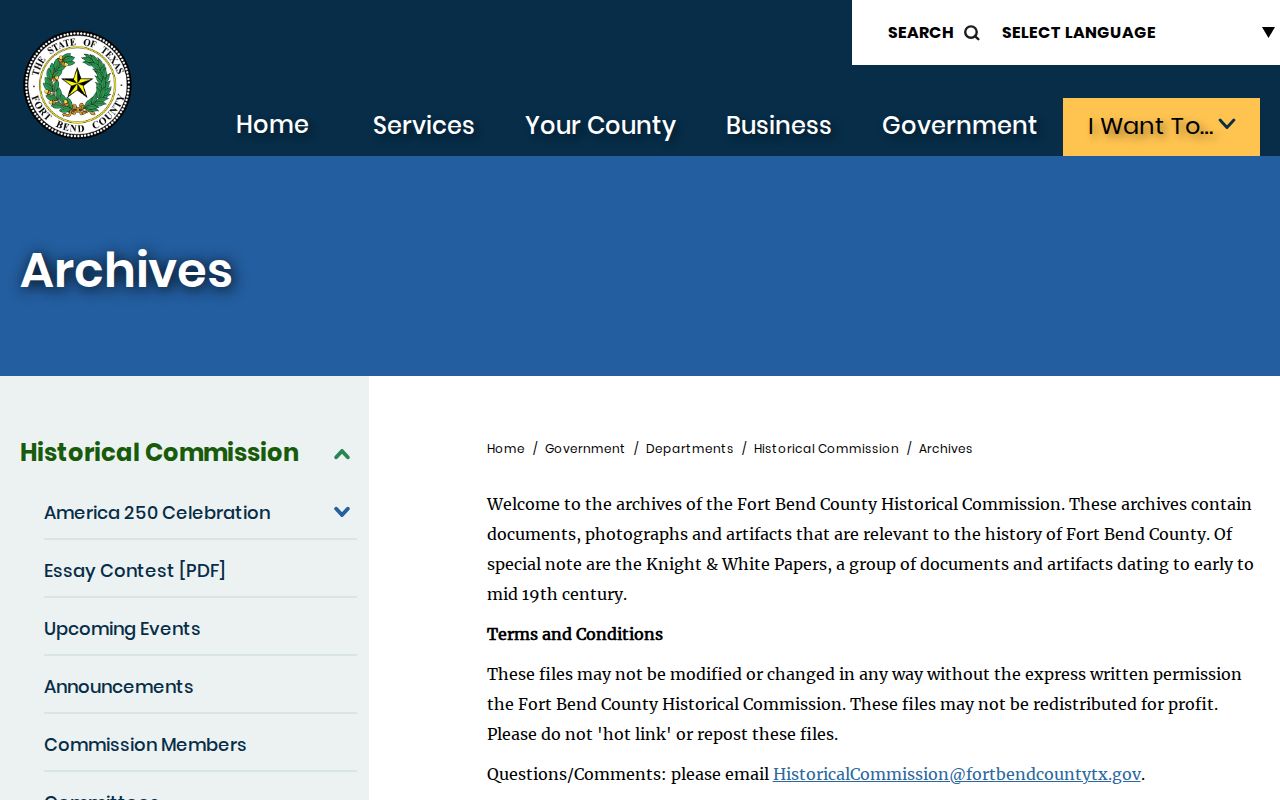
Use an oral history as a lead to a community name, school, church, or street memory, then preserve the item metadata and verify it against an original record. For the current address-keyed chain, use the Fort Bend County street directory.